- Log in / Sign up
-
- C$ CAD
- € EUR
- Rs. INR
- ¥ RMB
- $ USD
- My Account
- Notifications
- My Wishlist
- Support
-
+1-617-500-7002
- Chinese (Simplified)
Search for a place
Yellowstone tours run in summer, when the park roads are open, and board in Salt Lake City, Denver, Las Vegas, Los Angeles or San Francisco. How far you start from decides the shape of the trip: routes from Salt Lake City and Denver stay focused on Yellowstone and Grand Teton, while those from the coast run a week or more and treat the park as one stop alongside the Grand Canyon or Mount Rushmore. Hotels, transport and a guide are included throughout, and some itineraries include a cabin stay in or near the park — the tour page says which.
Four days is the most common length, boarding in Salt Lake City or Denver and covering Yellowstone's geyser basins, Grand Teton and Jackson Hole. Five and six day routes add time inside the park or a second gateway city. From the coast the same trip runs a week or more, with the Grand Canyon, Antelope Canyon or Lake Tahoe on the way. Hotels, transport and a guide are included. Some itineraries include a cabin stay in or near the park, stated on the tour page.


Pick a departure city to see the routes that leave from it, prices and how many days you'll need.
| Trip | Days | You'll see | From | Best for |
|---|---|---|---|---|
| Day tours | 1 Day | A single day in the park, for travelers already staying at one of the gateway towns | $360 | Already nearby |
| Short trips | 2-4 Days | Two to three days, staying close to Yellowstone and Grand Teton | $579 | A short break |
| Vacation packages | 5-16 Days | Four days and up, from Salt Lake City and Denver, or a week or more from the coast | $672 | The full trip |
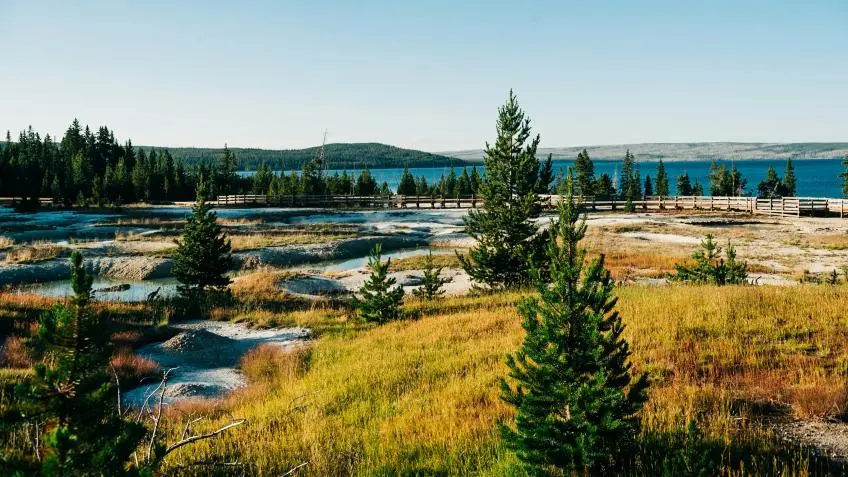
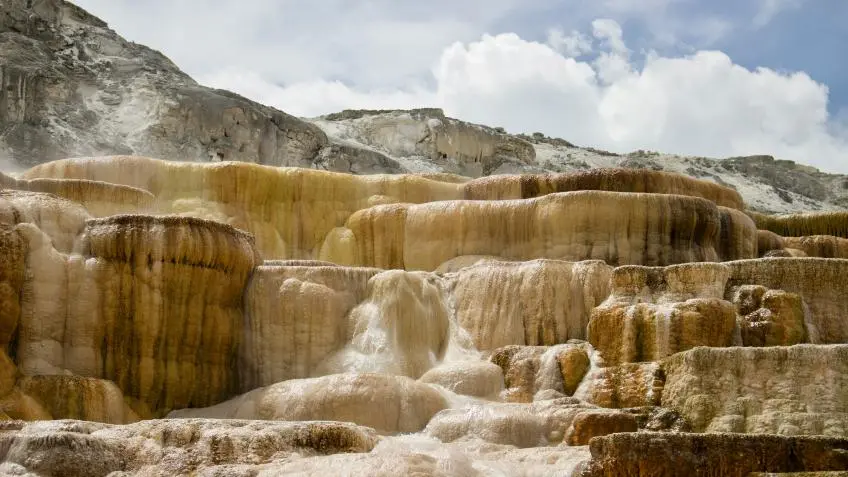
Yellowstone is not one kind of sight but several, and they sit hours apart along the park's loop road. Old Faithful is the geyser that erupts on a schedule regular enough to wait for. Fountain Paint Pot is the opposite kind of thermal feature — mud rather than water, bubbling in place instead of shooting up. Artist Point looks out over the canyon and waterfall the river cut through the park's own rock. Yellowstone Lake is the quiet one, a body of water large enough to have its own weather.


Four days is the shortest trip that works from Salt Lake City or Denver, and most of that is covered by distance rather than time at each stop. The park is large enough that the main thermal areas sit hours apart, and Grand Teton is a separate park to the south. Five and six day routes add time inside the park rather than more destinations. From the coast the same trip needs a week or more, because two of those days are spent reaching Wyoming.
The two parks share a boundary, and the road south from Yellowstone runs straight into Grand Teton and on to Jackson Hole. Adding it costs little in driving time and changes what you see — Yellowstone is thermal features and wide valleys, while Grand Teton is a mountain range rising directly from flat ground with no foothills in front of it. Tours from Salt Lake City pass through this way in both directions.
Tours run from around May to September, which is when the park's roads are open to coaches. Roads close for winter and reopen in stages in spring, so early-season itineraries can differ from mid-summer ones. July and August are the warmest and busiest months; the shoulder weeks at either end are quieter. Departure dates for each tour are listed on its page, and those are the definitive answer for any given year.
Often, but never on a schedule. Bison are the most commonly seen and sometimes cross the road in front of traffic. Elk, deer and pronghorn are widespread. Bears and wolves are possible but far less predictable, and sightings depend on where the group happens to be and when. Guides know which valleys and times of day give the best chance. Animals are viewed from the coach or from a distance on foot — approaching them is not permitted anywhere in the park.
Hotel accommodation, coach transport and a guide throughout the route. Park entrance is arranged as part of the tour rather than bought separately at the gate. Some itineraries include a cabin stay in or near the park, which is stated on the tour page — accommodation elsewhere on the route is in the gateway towns outside the boundary. All activities are optional, and the advertised price includes every mandatory fee.
Not always. Several routes are one-way — Denver to Salt Lake City is the most common, and routes from the coast sometimes finish in a different city again. The ending city is stated on each tour page. On one-way routes, return transport to the starting city is not included, so book your outbound and return flights to match before confirming the tour.
Thermal areas are crossed on raised boardwalks rather than trails, and the main viewpoints are short walks from the parking areas. The harder part is the driving — Yellowstone routes involve long stretches on the road each day, and days start early to reach the park. The park also sits at altitude, higher than any of the departure cities, which travelers arriving from sea level sometimes notice. Small-group options in vans carry fewer travelers than full coaches.
Meals are not usually included, and groups stop where travelers order individually. Food options inside the park are limited to lodges and visitor facilities, and the distances between them are long, so carrying water and something to eat is worth doing. Many tours carry a Vegetarian-Friendly label, meaning vegetarian options are available at the planned stops. Note dietary requirements when you book rather than on the day.
Tours board in Salt Lake City, Denver, Las Vegas, Los Angeles or San Francisco, depending on the route. Many include airport pickup for travelers arriving the same day. The exact pickup point and time are set by the route and shown on your confirmation, not chosen at checkout.
It depends on the route. Some tours return to the departure city and others finish elsewhere — Salt Lake City is the most common ending for one-way routes. The ending city is shown on each tour page, so confirm it before booking flights. Return transport to the starting city is not included on one-way routes.
Some do and some don't. Tours marked with a cabin stay include a night in or near the park; others use hotels in the gateway towns outside the boundary. Which applies is stated on each tour page. Staying closer means less driving at the start and end of the park days.
Guides on these tours speak English. Written itineraries and booking support are available in other languages — check the tour page for what each departure offers.
|
|||||||||
Please select your regions of interest (check all that apply):
|
|||||||||
 We will deliver great deals to your inbox!
|
||
Thank you for signing up for the TakeTours.com newsletter. |